

You've come to the right place. We offer equipment that will reduce production time and increase output.




-
Increased Efficiency
Automates the baling process, reducing manual labor.
Can bale continuously, covering more ground in less time.
-
Labor Cost Reduction
Minimizes the need for additional workers to gather and hand-pack pine straw.
One operator can harvest, bale, and move pine straw efficiently.
-
Increased Production Volume
Allows for multiple passes in a single day, increasing daily output.
Makes it possible to scale up your pine straw business or serve more clients.
-
Year-Round Utility
Can be repurposed for other materials (like hay or leaves) in off-season.
Extends ROI beyond pine straw alone.
-
Better Bale Density
Compresses straw tighter than hand baling, increasing storage and shipping capacity.
Denser bales resist weathering better if temporarily stored outdoors.
-
Perfectly Sized for Compact Tractors
Designed to operate with lower horsepower tractors (as low as 18-25 HP).
Lightweight and maneuverable in tight or wooded spaces common in pine plantations.




Contact

Small Farm Haying Independence Made Easy!
"You can bale when your pasture is at its nutritional peak—not when the farmer down the road gets around to it."
Do you operate a small farm? Do you own a little livestock and a few acres of hay pasture? Are you tired of waiting until the farmer down the road gets around to baling your hay—usually long after it has reached its nutritional peak? Then maybe it’s time for you to make the jump to haying independence. Fortunately, we at Tractor Tools Direct have developed a line of compact hay equipment that can help you do just that—and at a price that won’t break the bank!
Our company operates under the motto that “compact tractors do real work too”. We take pride in supporting the small farm operator who gets laughed out of the coffee shop for suggesting that his or her compact tractor can bale hay. That’s why we have partnered with manufacturers world wide to design machines that are ideally suited to small farm haying operations.
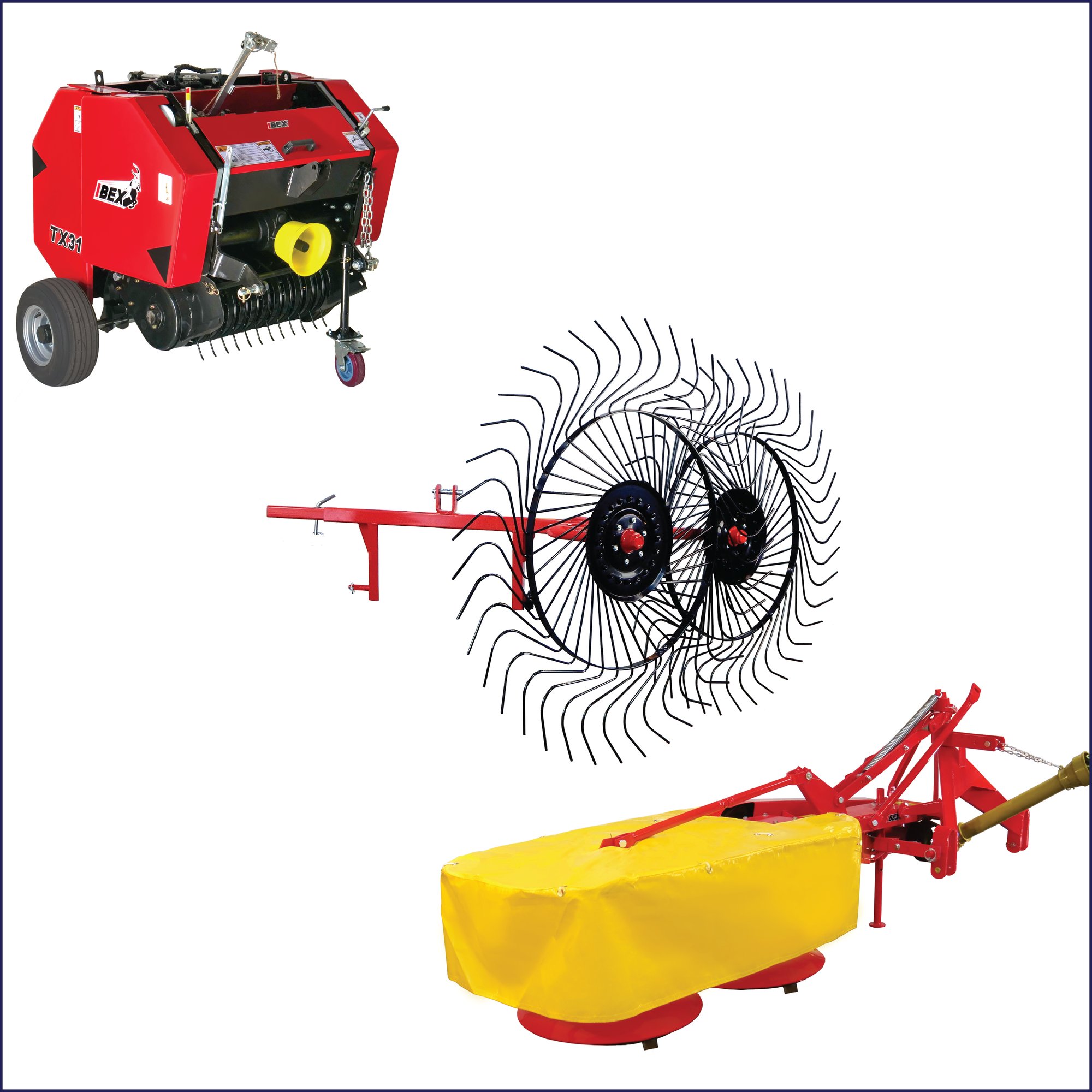
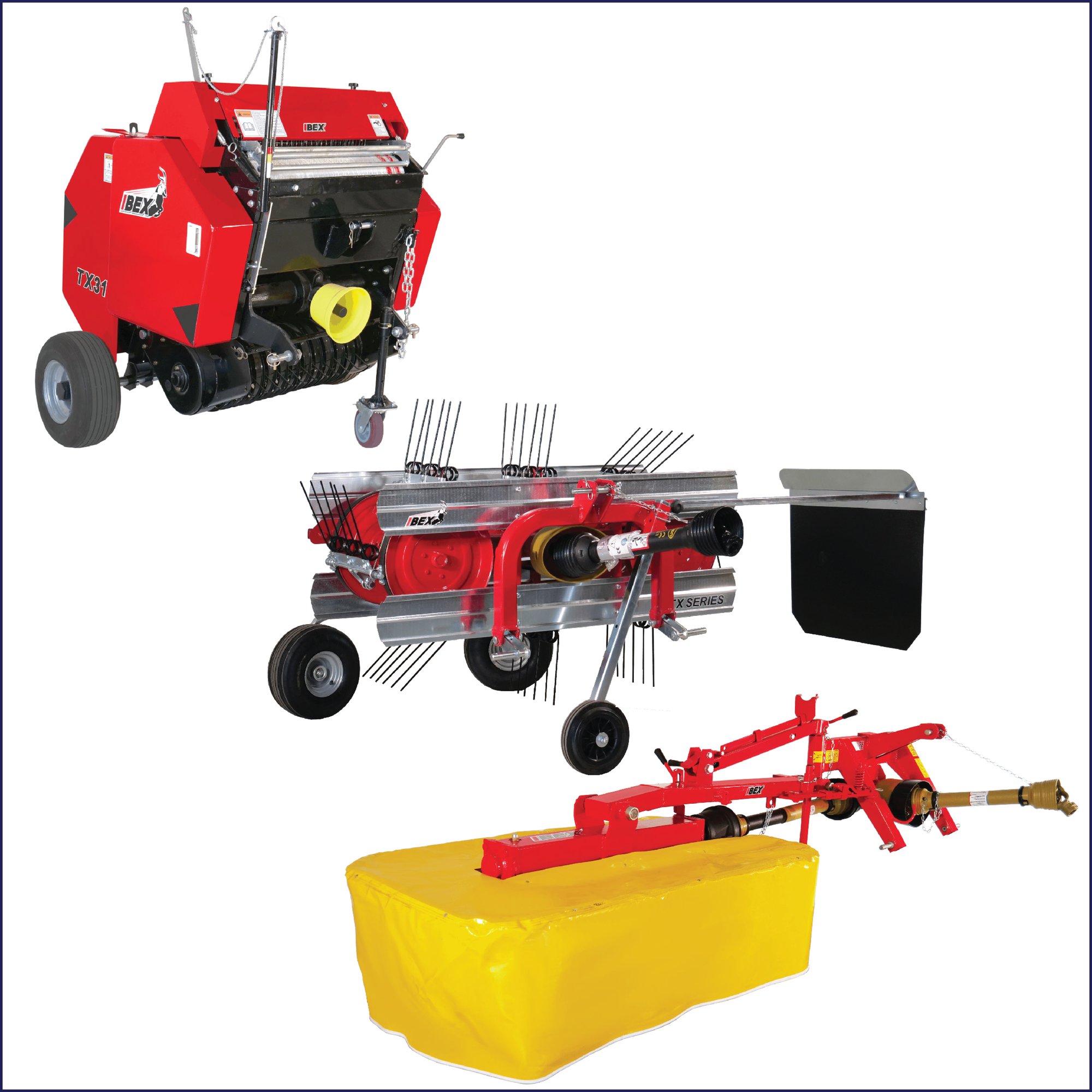
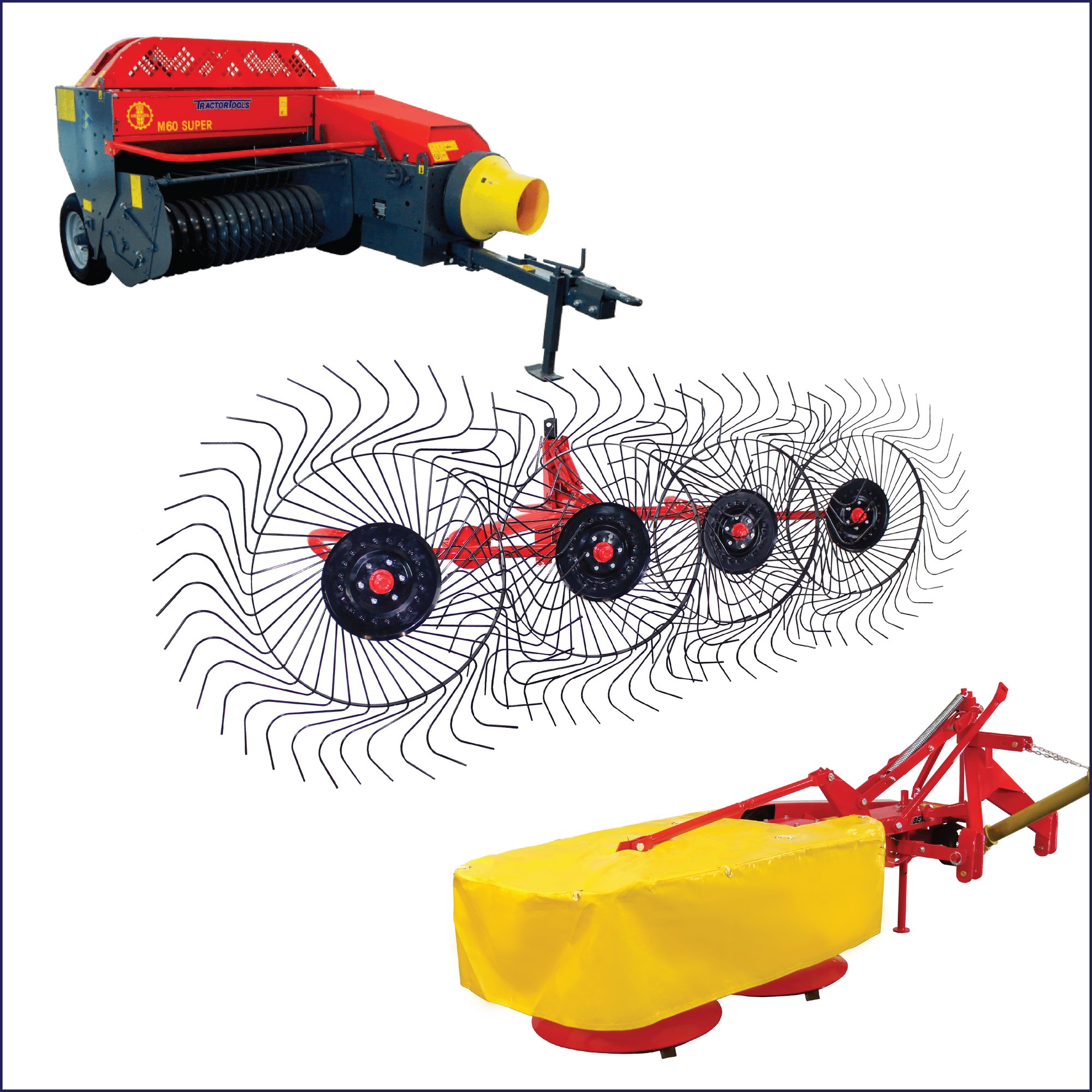
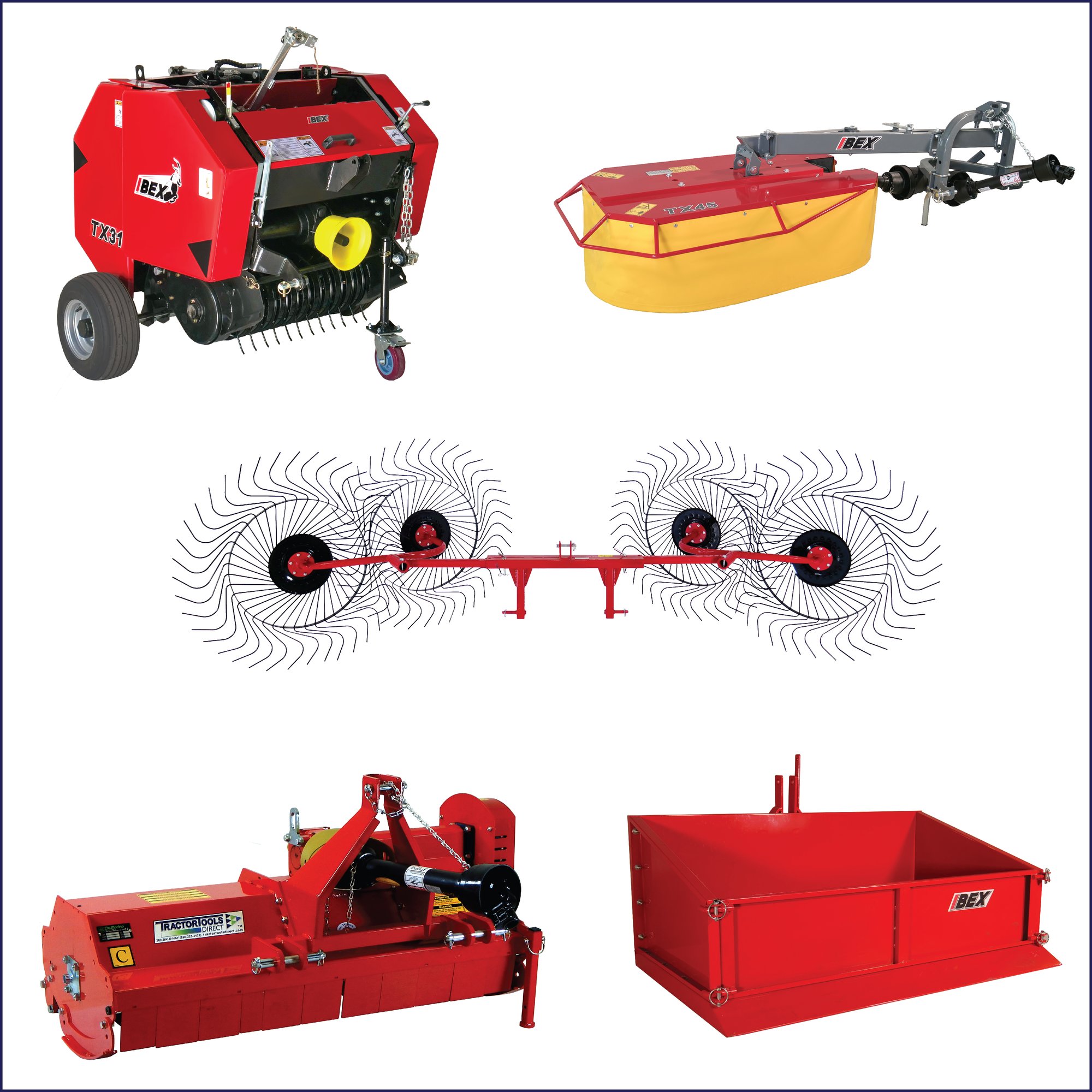
After much research and collaboration, we have done just that! We at Tractor Tools Direct are proud to offer our customers the Ibex Subcompact Homesteader Hay Package. This entire line of products—mower, rake and baler–has been specifically developed for the small farm operator on a small farm budget.
This package includes the Ibex TX45 Compact Drum Mower, the TX51 2 Wheel Rake, and the Ibex TX31 Mini Round Baler. All three implements are designed for the small farmer operating a compact tractor with a minimum 20 HP and wishing to bale up to 1,000 bales per year.
What are the Benefits of Baling Your Own Hay?
There are several reasons why a small-farm operator might want to consider baling his or her own hay. Of course, there is always the satisfaction of putting in a hard day’s work in the hayfield, but there are also other factors to consider. Some of these are:
- You can control the content of the bale. There is no question as to the nutritional value and cleanliness of the bale. You baled it, you know.
- You can bale when your pasture is at its nutritional peak—not when the farmer down the road gets around to it. Most contract balers bale too late opting for larger yields rather than quality yields. Simply put, your small acreage is of low priority to a contract baler.
- Owning your own compact hay equipment that is suited to the small size of your farm puts more of your acreage into production. Pastures and paddocks that are too small for standard hay equipment will no longer sit idle.
- You can control the size and density of your bales so that they work for you.You will not be at the mercy of supply and demand. You will be your own hay source.
- You can sell a little on the side. There is always a market for high quality hay!
Learn More About the Ibex Subcompact Homesteader Hay Package
"Pastures and paddocks that are too small for standard hay equipment will no longer sit idle."
The Ibex TX45 Compact Drum Mower
The Ibex TX45 Compact Drum Mower is perfectly suited for the small-framed tractors which are so popular with today’s landowner. Designed specifically for the lighter weight, narrower width, and smaller 3-point hitch of subcompact and compact tractors, the Ibex TX45 will cut faster and with fewer problems than other mowers on the market.
The manufacturer of Ibex Drum Mowers, situated in the Italian province of Padova, has been fabricating drum mowers for over 20 years. They have a proven design that has demonstrated its durability through years of use. Every drum is factory tested to be dynamically balanced, reducing vibration and prolonging machine life. Because of this exceptional attention to detail, the Ibex TX45 Compact Drum Mower is a high-quality machine that will give you years of trouble-free performance.
Ibex TX51 2 Wheel Rake
The Ibex TX51 2 Wheel Rake is designed to provide a gentle, cost-effective solution for your hay raking needs. Wheel rakes are the most economical choice for raking hay. With few moving parts, they are mechanically simple and require only very modest horsepower. A simple and economical alternative to powered rakes, the TX51 does not require a PTO or hydraulics. The rake is driven by contact with the crop being raked and the forward motion of your tractor and can operate at high ground speeds. It’s a perfect match for any subcompact or compact tractor.
The Ibex TX31 Mini Round Baler
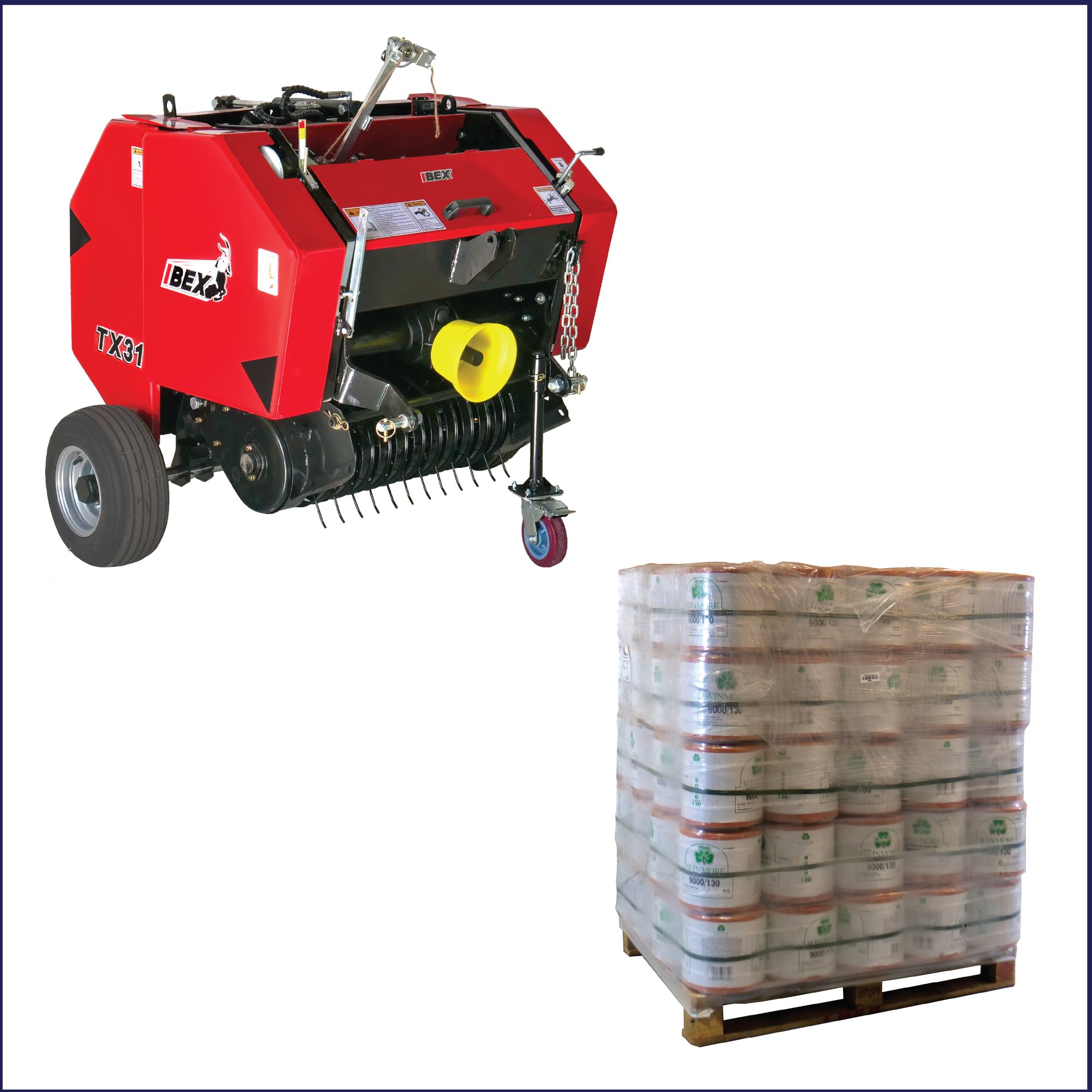
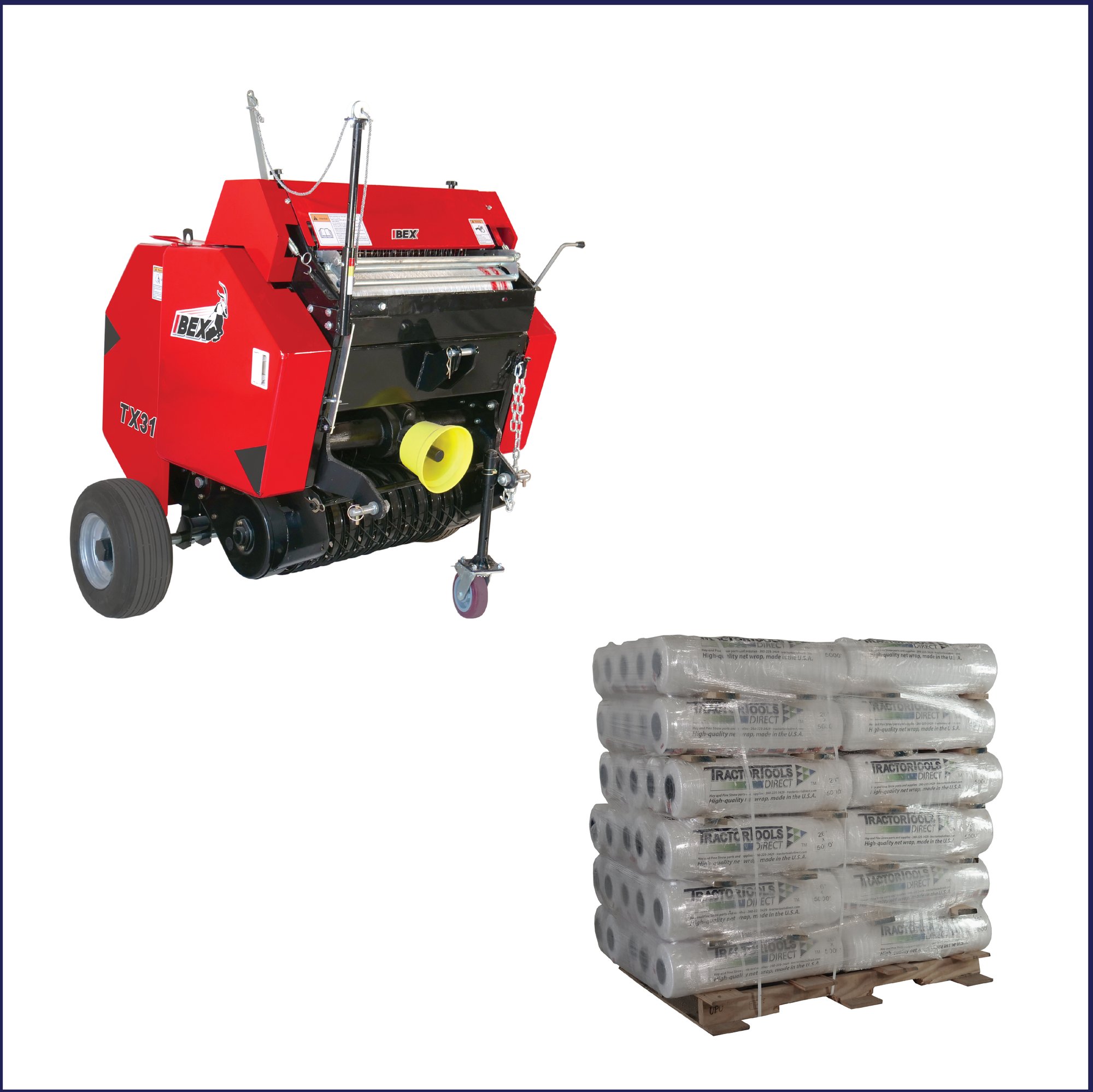
As a quality machine and the most affordable in the industry, the Ibex TX31 finally makes haymaking independence possible for the hobby farmer. The Ibex Mini Round Baler is the simplest, easiest to use mechanical baler on the market today and is as close as you can get to a “plug and play” baler. With the ability to produce 90 bales per hour, it’s perfect for small operations of 5-20 acres.
The Ibex TX31 produces a baler that is 28 inches long and 20 inches in diameter, making it easy to handle by hand. An average bale will weigh about 40 pounds, but this weight can be adjusted with the baler’s density setting. Bales stack neatly and compactly in the barn in a honeycomb pattern, reducing the risk of the stack toppling over.
The Ibex TX31 connects to the tractor’s 3-point hitch which allows for easy maneuverability in tight fields and paddocks. Its light weight, compared to square balers and large round balers, also enables safer operation on sloping ground. Furthermore, its small size means it can be easily stored in the corner of the barn or shed.
The Ibex TX31’s hydraulics are completely self-contained, meaning no messy hydraulic connections to deal with. It uses standard, inexpensive baler twine, either plastic or natural fiber, and can be run with any tractor of 15 horsepower or more. This baler is manufactured in China under the watchful eye of Ibex Equipment and, at the right size and the right price, allows more customers to take control of their own hay production.
Other packages available!
Think a different combination of implements might meet your needs better? No problem! We have nine hay packages available and can even work with you to customize one of your own! Visit our website here or give us a call at 1-260-BALE-HAY(260-225-3429). Our team is always happy to answer your questions to help you determine the equipment that would best meet your small farm’s needs! Make haying independence a reality today!
Pine Straw: The Perfect Mulch for Gardening and Landscaping
For many people, pine needles are simply a pesky, prickly nuisance that must be dealt with when cleaning up the Christmas tree or raking under the scotch pine in their front yard. However, pine needles have a lot of uses—some a little unconventional and others quite functional. They can be used to produce essential oils, natural soaps and household cleaners along with tea, tinctures and dyes. Varieties of long-leaf pines produce needles that can even be woven into baskets. Here at Tractor Tools Direct we are most familiar with their use as landscaping and gardening mulch—also known as pine straw.
What is pine straw?
If you’ve ever driven through the forested countryside of the southeastern United States, you’ve more than likely been awed by the vast, majestic pine stands that grace the landscape. These pine trees, though evergreen, go through a leaf shedding process very similar to their deciduous counterparts. However, since they shed the previous year’s growth while the current year’s growth remains, this shedding is not as obvious.
The most common pines of the southeastern United States are of the longleaf, slash and loblolly varieties. With lengths from nine to fourteen inches, the needles produced by these trees can be raked, cleaned of debris and baled, either by hand or machine, and marketed to landscapers and gardeners as pine straw. The bales produced can be round or square in shape weighing from twelve to forty pounds depending upon density. Machine-produced bales tend to be more compact.
What are the uses of pine straw?
The most common use of pine straw is as mulch in landscaping and gardening. Already used widely in the southeastern US due to its proliferation, pine straw is gaining popularity in other parts of the United States as well.
As a rule, pine straw can be used in a similar manner to wood mulch. It can be applied to gardens and landscaping beds to reduce weeds and maintain moisture levels. It can also be spread around the bases of trees to thwart weeds and thus reduce damage from mowers and trimmers. Pine straw’s uniform color and fine texture also creates a visually appealing groundcover around garden benches and trellises, along footpaths and between raised beds.
Pine straw also lends itself well to less obvious uses. The propensity of pine needles to knit or mat together makes pine straw the perfect ground cover for slopes and hillsides since it will not easily blow, wash or slide away. In cold temps, pine straw can be piled over tender perennials to protect them from freezing. The domed needles create a mini greenhouse effect which warms the soil and protects the roots and can be easily pulled away in the spring.
Why pine straw?
Pine straw performs like wood mulch in many ways; however, it also provides many unique benefits. Much like wood mulch, pine straw, applied as a ground cover, prevents evaporation of moisture, slows weed growth, prevents erosion, and stabilizes soil temperatures. As it decays it also provides nutrients and improves soil fertility.
In a lot of ways though, pine straw cannot be rivaled when it comes to mulching performance. Compared to wood mulch, particularly cyprus mulch which is produced by grinding up whole trees, pine straw is more environmentally friendly. Pine trees are not cut down to produce the straw. Their needles are simply harvested from the forest floor.
Furthermore, since pine straw acidifies the soil as it breaks down, it is perfect for use around acid-loving plants like rhododendron, blueberry, azalea and holly. This acidification is not to be a concern around other plants however since the level is no higher than that created by normal rain water. These slightly increased acidic conditions can also reduce some plant diseases. One grower swears by pine straw use in strawberry patches to reduce fungus and mold growth.
Another benefit of pine straw over wood mulch is the fact that it is less dense and does not compact as easily. This allows for better percolation of water to the soil beneath and minimizes water run-off. In super wet conditions, pine straw’s “fluffiness” aides in air circulation thus helping to maintain optimal soil moisture levels.
Pine straw can also serve as a natural repellent to unwanted critters in the garden. The slightly acidic smell and prickly texture deters voles, moles, slugs and even cats and dogs. Furthermore, when considering the type of mulch to use in landscaping beds or gardens that butt directly up to houses, barns or other wooden structures, one should keep in mind that pine straw does not attract termites as do some wood mulches.
Pine straw is also an economical choice. Because a typical pine straw bale covers a larger area than a bag of wood mulch, pine straw is generally the least expensive of mulches. This is especially true when added to the fact that pine straw breaks down more slowly than bark materials and will not need to be replaced as often.
How is pine straw applied?
One definite perk of pine straw is its ease of application. The bales are relatively light weight when compared to bags of wood mulch and are easy to maneuver and distribute. When deciding how much pine straw to purchase, it is important to keep in mind that 3 cubic feet of straw generally covers 60 square feet at 2-3 inches of depth.
As a rule, pine straw should be applied annually; however, if being used for decorative purposes, a biannual application will keep it looking fresh and more visually appealing. Though pine straw can be applied at any time of the year, applying it in the spring decreases weeds, heats the soil and increases soil tilth. The latter is especially true if some straw is gently forked into the soil reducing compaction and increasing oxygenation. A fall application can provide protection for root systems in freezing temperatures.
Before spreading straw, the bed should be cleared of debris and weeded. At this time, a weed preventer of choice can be applied. An initial distribution of straw should be about 3 inches in thickness in regular soil and up to 5 inches in dry, sandy soils. Annual reapplications should require little more than an inch per year. Don’t worry if the straw seems too fluffy at first. The straw will quickly settle especially after the first rain. Be sure to wear a thick pair of gloves—pine straw is quite prickly and can irritate the skin!
To protect trees and shrubs, try to keep the straw 2-3 inches from their bases. This will prevent rot and reduce the chances of rodents making their way to the bark for a tasty treat. To give your bed a more finished look, spread the straw just beyond the bed edge and slightly roll the edges with a rake or leaf blower.
What does pine straw have to do with Tractor Tools Direct?
Tractor Tools Direct customers are familiar with our high-quality compact hay-baling equipment. However, many are not aware that this equipment can also be used by pine straw producers. The same qualities that make our equipment perfect for the tight paddocks of a small farm make it perfect for the narrow tree rows of a pine plantation.
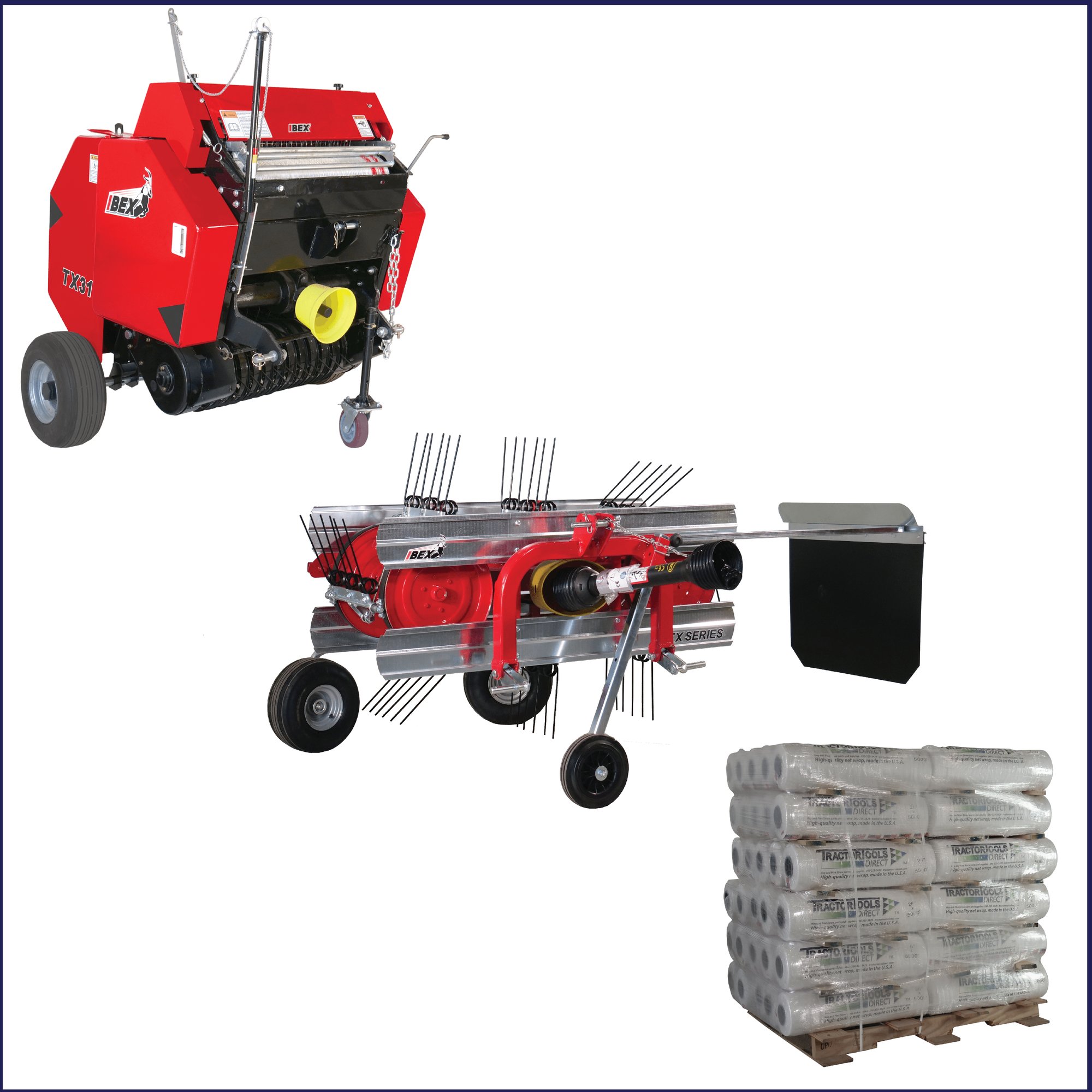
Many pine straw producers are making the switch from manual baling to mechanized tractor-powered balers. The impetus for this shift comes from an increasing difficulty in finding labor and an ever-increasing demand for their product. Producers are finding it more economical and efficient to invest in mechanized equipment.Tractor Tools Direct’s Ibex TX31 Mini Round Balers with Net Wrap are the perfect answer to the pine straw industry’s demands. Though many pine straw customers and retailers are accustomed to the small 15 to 20 pound square bales that are produced by the typical manual box baler, those who have begun selling round bales are finding them to be their bale of choice.
The bales produced by an Ibex TX31 Mini Round Baler with Net Wrap weigh approximately 35-40 pounds, making them easy to handle. Their cylindrical shape allows them to be simply rolled out onto landscaping beds and makes them far more efficient to apply than square bales. Net-wrapped bales do not shed needles the way the square bales do, resulting in less material loss during transportation. Furthermore, retailers, especially those of the big box stores, tend to find the sleek, clean look of round net-wrap bales to be more appealing to their customers.
The perfect complement to a pine straw baler is Tractor Tools Direct’s Ibex TX80 Belt Rake. This rake can be used in the restricted spaces of a pine plantation to mechanically prepare the windrows necessary for baling. Producers are finding that these machines greatly increase their production and reduce their dependence on the ever-dwindling supply of manual labor necessary for raking by hand.
In conclusion, pine straw, an abundant product of the southeastern United States, is a superior choice for landscape and garden maintenance. Its ability to reduce weeds and control soil moisture levels while providing a visually appealing ground cover is unrivaled. The pine straw industry is definitely one to watch in the upcoming years, and Tractor Tools Direct will continue to support it with our inventory of high-quality pine straw baling equipment.
Ready, Set, Mow: Preparing for the Hay Season
Perfect hay-baling conditions can be hard to come by, especially with the unpredictability of late spring weather. That’s why it’s crucial to start preparing for the hay season at least a month before your first cutting. In this blog, we’ll outline the steps to ensure your equipment, fields, and storage are prepared well before the first cutting.
Prepare Your Hay Baling Equipment
Ideally, much of the spring preparation should have been done the previous fall. If you followed advice from our earlier blogs, you’ve already cleaned and repaired your equipment before storing it for the winter. By now, you’ve hopefully made any necessary equipment purchases as well.
Since optimal conditions for the first cutting typically occur around May 15th in the southern US, and Memorial Day in the north, it’s time to start preparing by mid-April. It’s wise to purchase any parts and supplies ahead of time to avoid the late spring rush, which often leads to stock shortages. Some essential items to consider include baler twine or net, belts, mower blades, as well as rake, tedder, and baler tines. Ordering extras of these parts for both your equipment shed and tractor toolbox can be a lifesaver for quick field repairs.
It’s also essential to review your equipment’s owner’s manuals. This gives you a chance to assess any additional parts or supplies you might need, as well as refresh your memory on proper operating procedures.
Here are some key tasks to get your hay equipment ready:
- Check tire pressure.
- Adjust belt and chain tension.
- Lubricate moving parts (especially if you didn’t do this before winter).
- Replace dull or damaged mower blades.
- Set the pick-up height on your rake, tedder, and baler.
- Repair or replace any bent or damaged tines on your equipment.
- Inspect belts for cracks.
- Check baler hoses for leaks or cracks.
- Thread net wrap or twine, and inspect the mechanism.
Prepare Your Hay Fields
Once your equipment is ready, turn your attention to the fields. A quick walk-through will give you an idea of how your pastures are growing and help you time your first cutting. Most forages should be cut at the late boot stage, when seed heads begin to emerge. Keep an eye out for those, as they indicate it’s time to cut.
As you walk through your fields, remove any stones, trash, limbs, or other debris that might have accumulated over the winter. This is especially important along roadsides where debris may have blown in or near wooded areas where limbs and trees may have been felled by storms.
This is also a good time to inspect fences and gates. Check for any damage or areas that need repair, and make sure gates open, close, and latch properly. This may seem like a general maintenance task, but it’s crucial—no one wants to deal with a neighbor’s cows wandering through freshly windrowed hay!
Prepare Your Equipment Storage Sheds
The month before your first cutting is also a good time to clean and organize your equipment shed. Clear any clutter to ensure easy access to equipment. Gather hitches, lock pins, and tools, and store them in an easily accessible location. Also, organize your spare parts and supplies so you can quickly find them during an emergency.
Prepare Your Hay Storage Areas
Take some time to prepare your hay storage areas as well. Make room in the hay loft or shed for the upcoming season’s harvest. If you still have hay from the previous season, stack it separately to avoid mixing it with the new crop. Inspect your barn or shed for any leaks and make repairs as needed. If you plan to use a hay elevator for stacking, check to ensure it’s in working order.
Plan for Selling Your Hay
In the final weeks leading up to hay season, start thinking about your hay sales if you plan to sell. Begin by assessing your own livestock’s hay needs (you can use our “Livestock Winter Hay Needs” calculator to help). Once you’ve done that, contact past hay customers to see how much they’ll need. Reaching out early ensures you’ll have buyers lined up for your excess hay before it’s even baled.
Taking the time to prepare will pay off during the busy hay season. While it’s impossible to anticipate every challenge in hay production, these preparations will ensure you and your equipment are ready when your pastures are at their peak and the perfect stretch of late-spring weather arrives.
Once you have determined the parts and supplies you will need to prepare your hay equipment for the growing season, Tractor Tools Direct is here to help! Visit the following links to quickly place an order or find support:
- Parts
- Supplies
- Manuals
- Videos
- Maintenance
- Books
Prefer to speak to someone in-person? Give us a call at 260-BALE-HAY to speak to a member of our customer service department. We will be happy to assist! Happy Haying!
Pine Straw Production: A Personal Look at the Industry
In previous blogs, we have shared information about the pine straw industry and how our equipment, especially our Ibex TX31 Mini Round Baler with Net Wrap and Ibex TX80 Belt Rake, can be used to increase pine straw production. In this blog, we are taking a different approach. Tim Collins, TTD customer and owner of Quality Pine Straw Sales in Mississippi, gives us a personal look at the industry–from the baling process he follows, to the equipment he uses, to the product his customers expect.
You can learn more about Tim’s business through the following interview. You can also visit his website here. We appreciate his willingness to share his knowledge with us!
Could you tell us a little about your pine straw operation–name, location, history, operation, people involved?
We, Quality Pine Straw Sales, have been in business for 17 years. We began in 2004 in Northern Mississippi where we introduced pine straw to retailers, nurseries, landscapers, and homeowners. By 2016 our business had spread statewide, and we moved to the Mississippi Gulf Coast. We currently ship to all 48 continental states and use local people to do the work.
What is pine straw used for?
Pine straw is used to mulch beds of flowers etc…it helps retain moisture, it allows plants to breathe, it will not blow away or wash away, and it breaks down naturally providing nitrogen fertilizer for the soils underneath…. And pinestraw is all natural.
Could you briefly explain your process of producing pine straw?
First, pine straw fields are bush hogged, trimmed, and cut. Next, all large brush and small debris is cleared by hand. The first year we hand raked! We then use the Ibex TX31 Mini Round Baler with Net Wrap to bale the pine straw into rolls! After baling, the fields are sprayed twice a year to keep growth down. The second year we used a power rake to rake instead of hand raking. Once baled, the rolls are loaded on trailers and hauled to customers. Slash and longleaf are the two preferred pine straw varieties. Pine straw comes in round bales and square bales. Square bales are all hand baled.
What equipment do you use?
Tractors, bushings, sprayers, machine rake, IBEX TX31 and IHI balers, and more, but it's still real hands-on work.
How many bales do you produce each season?
We produce and sell around 75,000 rolls a year!
What are the benefits of mechanizing pine straw production?
This could not be done without it…….
Who are your customers and what type of product/bale are they looking for?
Our customers are homeowners, retailers, nurseries, landscapers, golf courses, construction companies, and on and on. They are looking for good freshly baled straw that has a good color. They are looking for good personal service year round. We help our resellers make money and provide a fair retail price for consumers. We also install pine straw for homeowners and apartment complexes. We even install pine straw for whole communities.
What, if any, challenges are facing the pine straw industry presently? How do you hope to overcome these?
As in any industry there is always someone doing it better, someone bigger always trying to buy everyone out! But no one company can supply everyone in this business. It takes good customer service, dependability, and you have to like what you do…..
One more thing, as in all other industries older generations are trying to pass the industry down and things are changing as people change. We must remain steady and consistent.
We want to help our customers, and I always find those that go away trying to find better——always call us back…..
What advice do you have for anyone thinking about entering the pine straw industry?
Get your check book out! It's not for the faint in heart! But we need more folks! Come on and join us! We always need new people getting involved.
Is there anything else you would like to share?
Our website is qualitypinestrawsales.com. We are here to serve customers both small and large. We try to help the small guys just like the big guys. We love all our customers and love to see them succeed! We love to see our retail customers happy and to see how beautiful their homes look when we get finished installing….
A big thank you to Tim for his interview! If you would like to learn more about how our equipment can help to improve your pine straw production, please visit our website or give us a call at 260-225-3429 today!
Preparing Your Fields for Hay Season
Are you getting spring fever yet? Here in west central Indiana, our predicted high temperature for this 20th day of February is 22°, I am certainly getting spring fever! Along with this spring fever comes my mental list of all the spring chores I need to get started on. For you hay producers this means preparing your hay fields for a bumper crop of high-quality hay. Ideally, the best time for hay field rejuvenation is late summer and early fall. However, a few steps in the spring will make great strides in maximizing your hay crop.
Now is the time to take a closer look at the spring preparations that will give you the highest tonnage yield and the highest feed quality of hay from your field. As I have said in past articles, it begins with a soil test. Without a soil test you are just making random guesses at what nutrients are needed. By randomly adding soil amendments you could be wasting money and time and possibly contributing to existing problems.
Fertilizing Your Hay Fields
Blindly broadcasting applications of products like 10-10-10 on hay fields can ultimately harm the yield. Long term, over application of phosphorus and potash make the crop virtually unresponsive to the fertilizer that is applied. According to a Purdue University article, over fertilization of forage crops can cut the yield by as much as 40% and greatly reduce the nutrient level of the hay for the animals that are eating it. Don’t get me wrong, fertilizing is the correct thing to do. However, year after year applications of equal percentage balanced fertilizer should never be the long term, sole source of fertilization.
Spring fertilization in hay fields will replenish nutrients removed by harvesting hay. You should rely on the results of your soil test to know the amount of fertilizer to apply. However, in the absence of a soil test, there are general maintenance recommendations for grass hay determined by the expected tonnage of harvested hay per acre. To determine this tonnage, you will need to know the number of bales you took off the field last year. What was the average weight of those bales? Multiply the number of bales by the average weight and divide by the number of acres of the field. This will give you a relative yield tonnage per acre to use for fertilization.
IE: 590 bales x 45LBS per bale = 26,550lbs total yield ÷ 5 acres = 5,310LBS ÷ 2000LBS = 2.65 tons per acre average yield.
A general fertilizer application recommendation per acre for grass hay is as follows. Nitrogen (N) – 40 to 60 pounds, phosphate (P) – 7 to 8 pounds, and potash (K) – 40 to 42 pounds per ton of hay removed.
Preparing the Field
If you’re working on a field that has not been cut for hay in the past, and especially a field that has been fallow for years past, a couple of other important steps will need to be taken. Look for any small trees and either pull them, dig them out, or cut them at ground level. Even the twig sized trees can damage your hay equipment.
Prepare the field for quality hay by mowing the field down to 1½” to 2” tall. Be sure the mowed material is evenly distributed over the full width of the mower and ensure there are no large clumps of material left behind the mower. A flail mower is ideal for this as it will leave an even mat of well chopped material. This should be completed now, well before spring growth has started.
In any hay field, take notice of thin or bare spots and ask yourself what the cause of the issue could be. Is this area in the margin of the field near a wooded area that gets limited sun? Is this an area that doesn’t drain well and would benefit from some minor excavation work and a few buckets of soil? Or does this area simply need to be reseeded? Now is the time to find and rejuvenate these areas.
Timing Hay Field Fertilization
So now you have your soil sample results and you know what amendments are needed. You’ve completed any minor excavation to address surface water issues as well as rough or rutted areas of your field. You’ve mowed down that remaining plant material in your new field. So, what now? Here in central Indiana, it’s time to hurry up and wait a few weeks, until noticeable growth has started – probably around the first of April. You should not fertilize dormant plants.
Once mid-April arrives, it's time to apply the recommended soil amendments. This will most likely include lime to adjust soil pH. (acidity) Soil pH in hay is crucial as it directly impacts the accessibility of nutrients to the plant. This not only affects the health and vigor of the plant but nutrient levels in the plant. Higher nutrient levels in the plant are vital for forage quality and animal nutrition. Once applied, lime will continue to control soil pH for several years.
For all your soil amendments the application method is important. Most items are in either powder or granular form and need to be evenly broadcast. Many people find that it is more economical to either rent the equipment to complete this or hire a custom application contractor.
When and How to Overseed Your Hay Field
Another subject that often comes up when discussing spring hay field prep is overseeding. There are many differing opinions on this subject. Here in the Midwest, my advice is to overseed in April. Overseeding is a relatively inexpensive technique to enhance the quality of your hay stand – especially when introducing legumes into your field. Early spring is a good time for this because of the reasonably reliable soil moisture expected. In any field you are going to overseed, first mow it down to 1½” to 2”.
On fields that you are over seeding, cut your nitrogen fertilizer application in half. Apply half of the recommended rate a couple weeks after seeding and the other half directly following the first cut of hay. This greatly reduces the chance of fertilizer burning on the new planting – especially in those areas where you have done any excavation or where areas of the field are thin.
Tilling Your Hay Field
Another quandary is whether to use some method of tillage on established hay fields before or after application of soil amendments or seeding to incorporate them into the soil. The answer to that question is going to depend on many factors. The first factor being who you ask, there are many differing opinions on this subject as well.
Because most of us are using small tractors, my personal advice is the use of a plug aerator as early in the year as possible, as soon as the soil is dry enough to work. A plug aerator is easy to pull and can be rented at many outdoor equipment rental facilities. When using a plug aerator, set it to run at 1½” to 2”. The use of a plug aerator slightly opens the soil to allow a higher percentage of the fertilizer to immediately get directly into the root zone, giving faster results. This also enhances germination rates when overseeding by allowing good seed to soil contact.
Maximizing Hay Yields
I know for many of you the subject of maintenance of a hay field sounds a bit foreign. After all, it’s just grass and possibly some clover or alfalfa growing naturally. This is true, but it’s the food for your animals that gets them through the winter. Maximizing the amount and quality of the hay you harvest from your field will mean the difference between feeding your own hay all winter or buying hay in late winter when it’s the highest priced and harder to find. Replenishing soil nutrients removed naturally by harvesting your hay will pay you back nicely. Especially for those of you who are selling hay. More bales of high quality hay means more money in your pocket.
As I’ve mentioned in this article, as with all aspects of farming, there are differing opinions of some of the steps to maximize both the quantity and quality of your hay. Be sure to consult with your local USDA extension agent for guidance.
If you have further questions about small farm hay production, be sure to check out our website or give us a call at 260-BALE-HAY today! Happy haying!